Every business today runs on data. But collecting data is only the starting point. The real question is – what do you do with it?
Two terms come up constantly in this conversation: predictive analytics vs data analytics. They sound similar, and people often use them interchangeably. However, they serve very different purposes – and confusing the two can lead to poor technology decisions and missed opportunities.
What Is Data Analytics?
Data analytics is the broad practice of examining raw data to draw useful conclusions. It covers everything from basic reporting to complex statistical modelling.
Think of it as an umbrella term. It includes several distinct types of analysis, each answering a different business question:
- Descriptive analytics – What happened?
- Diagnostic analytics – Why did it happen?
- Predictive analytics – What is likely to happen next?
- Prescriptive analytics – What should we do about it?
In most business contexts, when someone says “data analytics,” they are usually referring to the first two – descriptive and diagnostic. These look backwards at historical data to understand past performance.
To understand how data analysis works in practice, read our guide on how we analysis data across different research scenarios.
What Is Predictive Analytics?
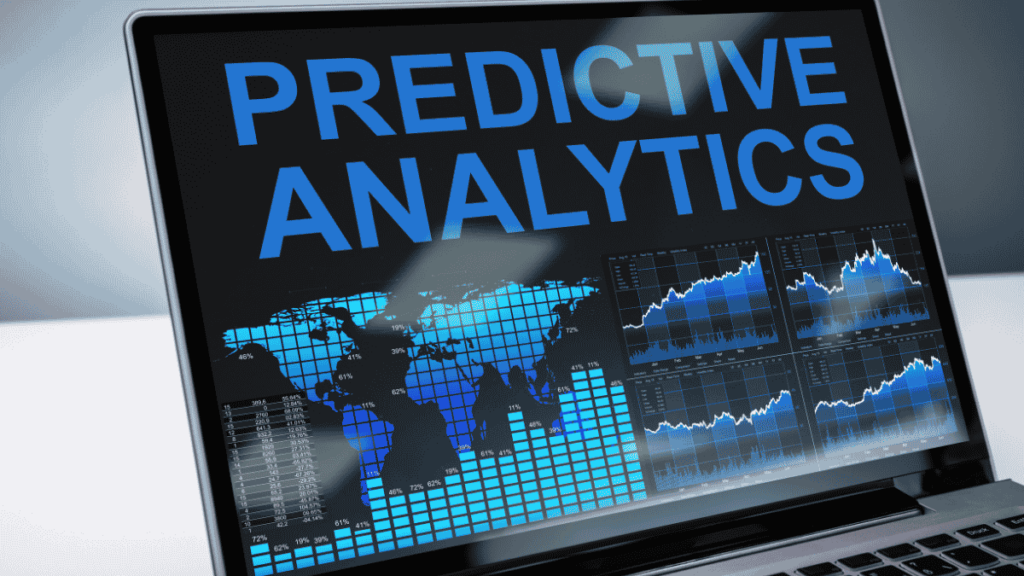
Predictive analytics is a specific subset of data analytics. It uses historical data, statistical algorithms, and machine learning to forecast future outcomes.
Instead of asking what happened, predictive analytics asks what is likely to happen next – and attaches a probability to that answer.
Common techniques used in predictive analytics include:
- Regression analysis – identifies relationships between variables to forecast values
- Decision trees – maps possible outcomes based on a sequence of decisions
- Neural networks – model patterns in complex, high-volume datasets
- Time-series forecasting – predicts future values based on historical trends
These models learn from past data. The more data they process, the more accurate their forecasts become over time.
Predictive Analytics vs Data Analytics: The Core Difference
The clearest way to understand the difference is through the questions each one answers.
| Data Analytics | Predictive Analytics | |
| Primary question | What happened? Why? | What will happen next? |
| Time orientation | Past and present | Future |
| Output | Reports, dashboards, trends | Forecasts, probability scores |
| Techniques | Aggregation, querying, visualisation | ML models, regression, classification |
| Skill requirement | Analysts, BI tools | Data scientists, ML platforms |
| Business use | Performance tracking | Risk scoring, demand forecasting |
Moreover, the two are not competing approaches. Predictive analytics depends on data analytics. You cannot build accurate forecasts without first understanding your historical data deeply.
For a broader comparison of these approaches, our article on predictive analytics vs data analytics explores additional dimensions of this distinction.
Turn Survey Data Into Business Decisions Faster
Technology-driven market research for faster, smarter insights.
Where Data Analytics Is Most Useful
Data analytics excels at giving organizations a clear picture of what has already happened. It is the foundation of business intelligence.
- Performance reporting: Monthly sales dashboards, website traffic reports, and quarterly financial summaries are all data analytics outputs. They tell you how the business performed against targets.
- Root cause analysis: When sales drop or customer churn increases, diagnostic analytics helps you trace the cause. It answers why – not just what.
- Operational monitoring: Tracking KPIs in real time across departments. Operations, marketing, finance, and HR all rely on data analytics for day-to-day visibility.
- Market research: Understanding customer behaviour, survey results, and segmentation data. This forms the basis of most research projects.
Data analytics is accessible, widely adopted, and applicable to almost every business function. It is typically the right starting point for organizations building their data capabilities.
Where Predictive Analytics Adds Greater Value

Predictive analytics goes a step further. It helps organizations act before events occur, rather than responding after the fact.
- Customer churn prediction: Identifying which customers are likely to leave – and triggering retention actions in advance. Telecoms, SaaS companies, and subscription businesses rely on this heavily.
- Demand forecasting: Retailers and supply chain teams use predictive models to anticipate inventory needs. This reduces overstock and stockout situations.
- Credit and risk scoring: Banks and financial institutions score loan applicants based on predictive models that assess default risk. This is one of the oldest and most established applications.
- Fraud detection: Predictive models flag unusual transaction patterns in real time. Payment processors and insurers use this to reduce financial losses.
- Healthcare outcomes: Predicting patient readmission risk, disease progression, or treatment response. Hospitals use this to prioritize care and allocate resources.
In each case, the business benefit is the same – acting on what is likely to happen, not just reacting to what has already happened.
The Four Types of Analytics – and Where They Fit
Understanding predictive analytics vs data analytics becomes clearer when you see all four analytics types together. They form a natural progression from insight to action.
Descriptive Analytics
Summarises historical data. Answers: What happened?
Example: A retail brand reviews last quarter’s regional sales performance across product categories.
Diagnostic Analytics
Investigates the causes behind outcomes. Answers: Why did it happen?
Example: The same brand identifies that a specific region underperformed because of a local competitor promotion.
Predictive Analytics
Forecasts future outcomes. Answers: What will likely happen?
Example: The brand’s model predicts which regions are at risk of underperforming next quarter – based on economic indicators, inventory levels, and competitor activity.
Prescriptive Analytics
Recommends specific actions. Answers: What should we do?
Example: The system recommends adjusting pricing, reallocating stock, and activating a targeted campaign in the at-risk regions.
Prescriptive analytics is the most advanced tier. To see how it works in practice, explore our examples of prescriptive analytics and the decisions they support.
Common Misconceptions About Predictive Analytics
Misconception 1: Predictive analytics guarantees accurate forecasts.
It does not. Predictive models generate probabilities, not certainties. A model that predicts churn with 85% accuracy still gets it wrong 15% of the time. The quality of predictions depends on data quality, model design, and how well the historical data reflects current conditions.
Misconception 2: You need big data to use predictive analytics
Not necessarily. Even mid-sized datasets can support useful predictive models, provided the data is clean, relevant, and well-structured. Data quality matters more than data volume.
Misconception 3: Predictive analytics replaces human judgment
It informs decisions – it does not make them. A churn model tells you which customers are at risk. Your team still decides what action to take and when.
Misconception 4: Data analytics and predictive analytics are the same
This is the most common source of confusion. Data analytics looks backward. Predictive analytics looks forward. Both are valuable, but they require different tools, skills, and data infrastructure.
Turn Complex Datasets Into Strategic Business Growth
Enterprise-grade data processing, statistical analysis, and customized tabulations to power your insights.
Which One Does Your Business Actually Need?
The answer depends on your current maturity level and your most pressing business problem.
Start with data analytics if:
- You do not yet have reliable reporting in place
- Your teams lack visibility into basic performance metrics
- Your data is fragmented across systems and not centralized
- You are early in building your data and analytics capabilities
Move to predictive analytics when:
- You have clean, consistent historical data available
- You are dealing with forecasting, risk, or demand planning challenges
- You want to shift from reactive to proactive decision-making
- Your team has the skills – or a partner – to build and interpret models
In most cases, the two work best together. Data analytics provides the historical foundation. Predictive analytics builds the forward-looking intelligence on top of it.
To understand the foundational distinctions between data analysis and data analytics, our article on data analysis vs data analytics explained simply covers this well.
Key Takeaways
- Data analytics is the broad practice of analysing historical data for insights and reporting.
- Predictive analytics is a specific, forward-looking subset that forecasts future outcomes.
- The two are complementary – not competing – approaches.
- Most businesses should build data analytics capability first, then layer in predictive models.
- The right approach depends on your data maturity, business goals, and available expertise.
Program Complex Questionnaires and Skip Logic
Expert survey scripting, advanced routing, and multi-language configurations for flawless data collections.
Frequently Asked Questions
Data analytics focuses on understanding what has already happened – through reports, dashboards, and historical trend analysis. Predictive analytics uses historical data to forecast what is likely to happen in the future. One looks backwards; the other looks forward.
Yes. Predictive analytics is a subset of the broader data analytics discipline. Data analytics includes descriptive, diagnostic, predictive, and prescriptive analytics. Predictive analytics is the third tier in this progression.
Financial services, retail, healthcare, telecommunications, and e-commerce are among the heaviest users. Any industry dealing with customer churn, demand forecasting, risk scoring, or fraud detection benefits significantly from predictive models.
Not necessarily at the early stage. Most small businesses benefit more from solid descriptive analytics first – clean reporting and KPI tracking. Predictive analytics becomes valuable once you have consistent historical data and a clear forecasting challenge to solve.
Common tools include Python (with scikit-learn), R, IBM SPSS, SAS, and platforms like Microsoft Azure ML and Google Vertex AI. The right tool depends on your team’s technical capability, data volume, and the complexity of the models you need to build.