Not every survey is a simple list of questions. Some studies need nested logic, strict quotas, randomized concepts, and multiple languages, all working together without a single error. This is where complex survey programming becomes essential, and where small mistakes can quietly ruin an entire dataset.
At Linkinfotech, we build and test these advanced surveys for research teams that can’t afford hidden errors. In this guide, we’ll explain what complex survey programming involves, where projects commonly go wrong, and how to manage advanced builds with confidence.
What Is Complex Survey Programming?
Complex survey programming is the technical process of building surveys with advanced logic, layered rules, and specialized research methods. These surveys go far beyond simple lists of questions. They adapt in real time to each respondent and often integrate with external systems.
A simple customer feedback form might need only a few skip rules. In contrast, a multi-market brand study can require dozens of quotas, loops, and conditional paths. Therefore, complex survey programming demands both technical skill and careful planning.
Every advanced build begins with documentation. A detailed survey script defines each rule, path, and exception before programming starts, giving the team one shared source of truth.
Turn Survey Data Into Business Decisions Faster
Technology-driven market research for faster, smarter insights.
What Makes a Survey Complex?
Several features push a project from simple to complex. Often, a single survey combines many of them.
- Nested skip logic – Conditions that depend on several earlier answers.
- Multiple quota layers – Overlapping or interlocked sample targets.
- Loops and iterations – Question blocks repeated for each brand or product.
- Randomization and rotation – Controlled variation in order and exposure.
- Advanced methods – Conjoint, MaxDiff, and other choice-based exercises.
- Multilingual versions – Identical logic across several languages.
- Hidden variables and piping – Calculated values and dynamic text.
- External integrations – Panel links, redirects, and data exchanges.
Each feature adds power. However, each also adds risk, since more moving parts create more chances for something to break.
Why Complex Survey Programming Needs Special Care

Complex surveys fail in quieter ways than simple ones. A broken rule might affect only one respondent group, so the error stays hidden until analysis begins. Consequently, careful planning matters more as complexity grows.
Here’s why extra care pays off:
- Hidden errors – Problems appear only in rare answer combinations.
- Costly mistakes – Re-fielding wastes samples and budget.
- Longer testing – More paths mean more checking.
- Higher dependency – One faulty rule can affect many later questions.
- Team coordination – Several people must understand the same logic.
Therefore, teams should treat complex builds as engineering projects, not just questionnaires.
Core Techniques in Complex Survey Programming
Experienced programmers rely on a handful of core techniques to manage complexity.
Advanced Branching
Branching routes respondents through different paths based on layered conditions. For example, age, product usage, and region together might decide which section appears next.
Layered Quotas
Programmers set simple, interlocked, and priority quotas to balance the sample across several dimensions at once. These controls also stop overfilled groups from entering the survey.
Loops and Nested Loops
Loops repeat a question set across a list of items without duplicating work. Nested loops add another layer, such as brands within categories.
Randomization
Randomizing questions, answers, or concepts reduces order bias. Balanced rotation also ensures each concept receives similar exposure.
Piping and Dynamic Content
Earlier answers feed into later questions, creating a personalized, connected experience.
Custom Scripting
When standard tools fall short, programmers add custom code to handle special calculations, validations, or displays.
Platforms such as the Decipher survey platform support many of these techniques, which is why advanced teams often prefer them for demanding projects.
The Complex Survey Programming Workflow
A disciplined workflow keeps large projects under control. Most strong teams follow a similar sequence.
Step 1: Review and Clarify
Programmers study the questionnaire and flag anything unclear. Ambiguous routing or missing answer options get resolved before building starts.
Step 2: Map the Logic
Next, the team draws every path, quota, and hidden variable. A visual map often exposes conflicts that written text hides.
Step 3: Build in Modules
Instead of programming everything at once, programmers build and test one section at a time. This approach isolates problems early.
Step 4: Integrate and Test
Once modules work individually, the team connects them and tests the complete flow.
Step 5: Run Quality Assurance
Dedicated testers check logic, text, quotas, and data output against the approved specification.
Step 6: Soft Launch
A small pilot batch reveals real-world issues before the full sample enters.
Step 7: Launch and Monitor
Finally, the team opens the survey and tracks completions, dropouts, and quotas closely.
Teams learning the platform side can strengthen their skills through a practical Decipher tool tutorial, which shows how these steps translate into real builds.
Turn Complex Datasets Into Strategic Business Growth
Enterprise-grade data processing, statistical analysis, and customized tabulations to power your insights.
Common Mistakes in Complex Survey Programming
Industry experience points to several recurring errors. Recognizing them helps teams avoid repeating them.
Skipping Pre-Testing
Teams sometimes launch without piloting the survey. Unclear wording, confusing routing, and technical glitches then reach real respondents.
Overcomplicated Logic
Poorly nested conditions, inconsistent routing, and accidental loops can trap respondents or send them to the wrong questions. Careful review prevents these traps.
Ignoring Mobile Design
Many respondents answer on phones. Surveys that don’t adapt to small screens lose participants and weaken response quality.
Overloading Respondents
Long, repetitive questionnaires cause fatigue. As a result, answers become rushed, incomplete, or inaccurate.
Weak Error Handling
Without proper validation, respondents can submit blank, illogical, or invalid answers. Clear error messages help them correct mistakes.
Overlooking Accessibility
Surveys should work with keyboard navigation, screen readers, and descriptive image text. Ignoring accessibility excludes participants and can bias the sample.
Rushed Quality Assurance
Limited testing and too few reviewers let errors slip through. Involving multiple stakeholders improves detection.
Managing Complexity With Documentation
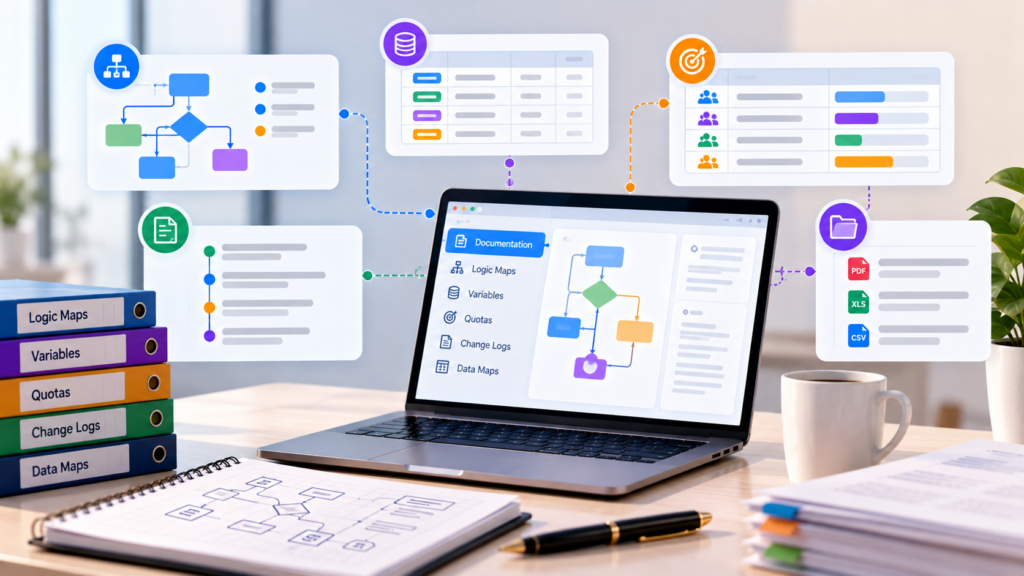
Documentation becomes a lifeline on large projects. Without it, knowledge lives only in one programmer’s head, which creates serious risk.
Good documentation typically includes:
- Logic maps – Visual diagrams of every path and condition.
- Variable lists – Names, types, and purposes of all hidden values.
- Quota tables – Targets, priorities, and qualifying rules.
- Change logs – Records of every edit and its reason.
- Data maps – Clear labels linking questions to exported variables.
These records speed up testing, simplify handovers, and make future updates far less stressful.
Complex Programming in Market Research
Advanced builds appear most often in large market research survey projects. Brand trackers, concept tests, and pricing studies all depend on precise logic and balanced samples.
Recurring programs add another challenge. Organizations running ongoing marketing research in services work need consistent programming across waves, so trend data stays comparable. Any unplanned change can break that comparability.
Standard survey programming skills form the foundation here, but complex projects stretch them with specialized methods and tighter quality demands.
Protecting Data Quality in Advanced Builds
Data quality depends on every earlier decision. Strong validation, tested routing, and clean exports all contribute.
Programmers can add several safeguards:
- Speeder checks – Flag respondents who finish unrealistically fast.
- Straight-lining detection – Catch repeated answers down a grid.
- Attention checks – Confirm respondents read questions carefully.
- Duplicate prevention – Block repeat completions.
- Open-end screening – Identify gibberish or copied text.
These controls support sound data collection and survey outcomes, especially when sample costs are high and every complete matters.
From Complex Build to Clear Insight
The payoff of careful programming arrives during analysis. Clean structure, accurate labels, and reliable routing let analysts focus on findings rather than fixes.
For example, cross-tabulation depends on complete, correctly routed data. If skip logic fails, each segment may contain the wrong respondents, and comparisons become misleading.
Likewise, well-structured exports move smoothly into many data analysis tools. Analysts can then model relationships and test hypotheses without wrestling with messy files.
When to Bring in Specialist Support
Some projects outgrow in-house capacity. Specialist support makes sense when:
- Logic is unusually deep – Many layers or loops increase error risk.
- Advanced methods are required – Conjoint or MaxDiff need specialist design.
- Deadlines are tight – Experienced teams build faster.
- Multiple markets are involved – Translation and consistency add coordination work.
- Internal bandwidth is limited – Researchers need time for analysis and client work.
Choosing a partner with real platform expertise and a rigorous testing process protects both budget and data.
Best Practices for Complex Survey Programming
- Finalize the questionnaire before programming begins.
- Write a clear, unambiguous specification.
- Build and test in small modules.
- Keep logic as simple as the research allows.
- Use independent testers for quality assurance.
- Test on desktop and mobile separately.
- Document every rule, variable, and change.
- Run a soft launch before the full sample.
Following these habits turns complicated builds into manageable, repeatable processes.
Program Complex Questionnaires and Skip Logic
Expert survey scripting, advanced routing, and multi-language configurations for flawless data collections.
Conclusion
Complex survey programming demands more than technical skill. It requires planning, documentation, disciplined testing, and clear communication across the whole team. When these elements work together, advanced surveys deliver accurate, trustworthy data.
Teams that respect complexity, rather than underestimate it, avoid the costly errors that plague rushed projects. As research methods grow more sophisticated, this discipline will only become more valuable.
Ultimately, complexity itself isn’t the problem. Poorly managed complexity is.
Frequently Asked Questions
It’s the building of surveys with advanced logic, layered quotas, loops, randomization, and specialized methods like conjoint or MaxDiff.
Common errors include skipping pre-tests, overcomplicating logic, ignoring mobile design, weak error handling, and rushed quality assurance.
Timelines vary, but advanced projects often need two to four weeks, including documentation, testing, and a soft launch.
It records logic, variables, and changes, which speeds up testing, simplifies handovers, and reduces the risk of costly errors.
Outsourcing helps when logic is very deep, deadlines are tight, advanced methods are needed, or internal bandwidth is limited.