Global research rarely happens in one language. A brand study might cover five countries, and a customer feedback program might serve dozens of communities. Decipher multilingual surveys let researchers meet respondents in their own language while keeping one consistent structure behind the scenes.
At LinkInfoTech, we program and test multilingual surveys so every language version follows the same logic and delivers comparable data. In this guide, we’ll explain how multilingual surveys work in Decipher, what challenges to expect, and how to build them so every language version performs equally well.
What Are Decipher Multilingual Surveys?
Decipher multilingual surveys are single projects that display in several languages. Respondents choose, or are routed to, the version they understand best. Meanwhile, all answers flow into one dataset.
This design offers a major advantage. Researchers maintain one set of logic, quotas, and reporting instead of managing separate surveys for each market. Therefore, updates happen once, and comparisons across countries stay clean.
Every multilingual build starts with a master version. A detailed survey script in the base language defines every question, rule, and exception, giving translators and programmers a shared reference.
Why Multilingual Surveys Matter
Respondents answer more accurately in their native language. Moreover, translated surveys reach people who would otherwise skip a foreign-language questionnaire. As a result, samples become more representative.
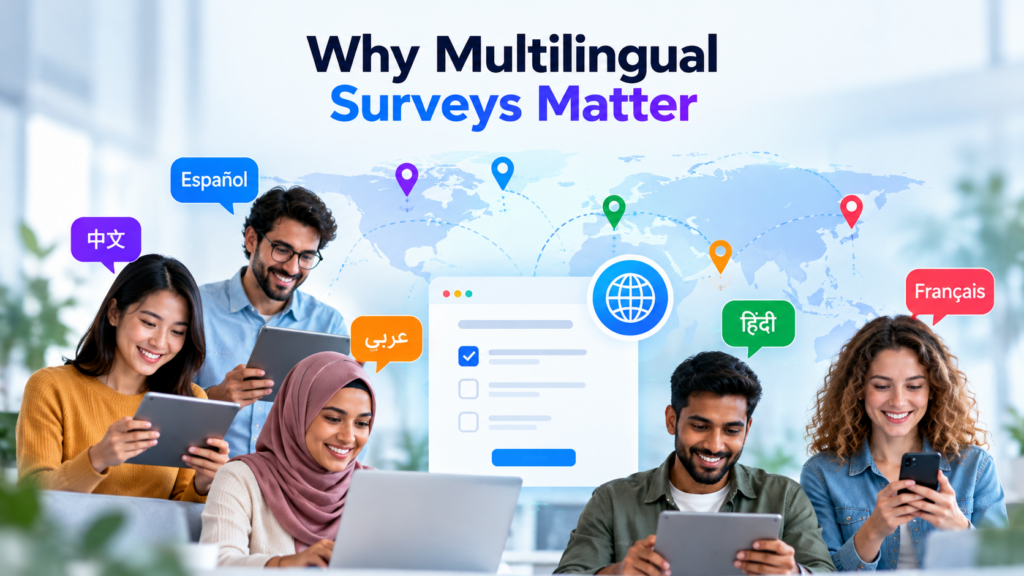
Here’s why multilingual surveys deliver value:
- Higher response rates – People engage more with familiar language.
- Better answer quality – Nuance survives when respondents read in their own language.
- Wider reach – Studies cover regions and communities that English-only surveys miss.
- Unified analysis – One dataset supports direct comparison across markets.
- Consistent logic – Every language follows identical routing and rules.
Additionally, multilingual design signals respect for respondents, which can improve trust and completion.
How Decipher Multilingual Surveys Work
The process follows a clear sequence. Understanding each stage helps teams plan timelines and avoid surprises.
Step 1: Build the Master Survey
Programmers complete the survey in the base language first. They finalize logic, quotas, validation, and design before translation begins.
Step 2: Prepare Text for Translation
All respondent-facing text gets collected for translators. This includes questions, answer options, instructions, error messages, and button labels.
Step 3: Translate and Localize
Professional translators adapt the text for each language. Good localization goes beyond word-for-word conversion. It adjusts tone, examples, and cultural references.
Step 4: Load and Connect Translations
Programmers add each language version to the project, linking translated text to the correct questions.
Step 5: Test Every Language
Testers complete the survey in each language, confirming that logic, display, and data output match the master version.
Step 6: Launch and Monitor
After a soft launch, the survey opens to the full sample while teams track completes by language.
Teams new to the platform can speed up this process with a practical Decipher tool tutorial, which shows how the pieces fit together.
Turn Survey Data Into Business Decisions Faster
Technology-driven market research for faster, smarter insights.
Language Selection and Routing
Respondents need a simple way to reach the right version. Several approaches work, and each suits a different project.
- Automatic detection – The survey reads browser language and displays a matching version.
- Manual selection – Respondents choose a language from a list at the start.
- Panel or link-based routing – The sample source passes a language code in the survey link.
- Country-based assignment – Respondents see the language tied to their market.
Whichever method you choose, offer an easy way to switch languages. A respondent who lands in the wrong version should never feel stuck.
Managing Quotas Across Languages

Language often connects directly to sample design. For example, a study may need 500 completes in each of four languages.
Decipher quotas can create cells for each language, which keeps the sample balanced across markets. This feature makes multilingual fieldwork easier to control, since each language fills independently. Well-planned survey programming ensures these quota cells match your research design before launch.
Priority settings also matter. If respondents qualify for several cells, clear rules decide where they land. Testing these paths in every language prevents imbalanced samples later.
Key Technical Considerations
Translation introduces technical risks that don’t appear in single-language projects. Careful programmers watch for several issues.
Text Length
Translated text often runs longer or shorter than the original. German and Spanish, for example, can expand significantly. Layouts must absorb these differences without breaking.
Right-to-Left Languages
Arabic, Hebrew, and Persian read from right to left. Surveys must flip direction correctly while keeping grids, scales, and buttons usable.
Character Encoding
Special characters and accents need proper encoding. Otherwise, text may appear as broken symbols.
Dynamic Text and Piping
Piped answers must read naturally in every language. Grammar rules differ, so inserted words sometimes need adjustment.
Rating Scales and Labels
Scale wording should carry equal meaning across languages. A “somewhat agree” in English may not translate neatly everywhere.
Common Challenges and How to Avoid Them
Even experienced teams hit predictable problems. Recognizing them early saves time.
- Late questionnaire changes – Edits after translation create mismatched versions.
- Incomplete translations – Missing text leaves portions in the wrong language.
- Inconsistent logic – Errors during loading can break routing in one language.
- Poor localization – Literal translation confuses respondents.
- Skipped testing – Untested languages hide display and logic errors.
- Unclear ownership – Nobody tracks which version is current.
Fortunately, freezing the master survey before translation and testing every language prevents most of these issues.
Turn Complex Datasets Into Strategic Business Growth
Enterprise-grade data processing, statistical analysis, and customized tabulations to power your insights.
Testing Decipher Multilingual Surveys
Testing multiplies with each added language. However, shortcuts here create expensive mistakes.
Testers should complete every language version from start to finish. They should check text, routing, validation, and data output. Furthermore, native speakers should review translations in context, since errors often hide in layout and tone rather than vocabulary.
Platform tools help. The Decipher survey platform includes testing features that let teams switch languages, view labels, and confirm that each version matches the master. Combining these tools with a structured QA checklist keeps projects reliable.
Multilingual Surveys in Market Research
Cross-market studies depend heavily on this capability. A global market research survey must ask identical questions in every country to produce comparable results. Even small translation differences can distort comparisons.
Brand trackers, concept tests, and customer satisfaction programs all benefit. Because these studies often repeat across waves, a well-built multilingual structure saves effort each cycle.
Data Quality Across Languages
Consistency protects data quality. When every version follows identical logic, researchers can merge responses confidently.
Strong data collection and survey practices also include monitoring by language. Watch completion rates, dropout points, and response times for each version. A spike in dropouts in one language often signals a translation or display problem.
Open-ended answers need extra care. Responses arrive in multiple languages, so teams must plan translation or coding before analysis begins.
Service and Feedback Surveys in Many Languages
Multilingual design isn’t limited to large research projects. Businesses serving diverse communities also benefit. A simple service survey form offered in several languages collects feedback from customers who might otherwise stay silent.
This approach improves inclusion and gives managers a clearer view of satisfaction across customer groups.
Analyzing Multilingual Results
Once fieldwork ends, analysis compares groups across languages and markets. Analysts often start with cross-tabulation to see how responses differ by language or country.
However, interpret differences carefully. A gap between markets may reflect real attitudes, but it can also reflect translation nuance or cultural response styles. Checking base sizes and reviewing question wording helps avoid false conclusions.
Teams can then explore different data analysis tools to model relationships and test findings. Clean, consistently labelled data makes this step far easier.
Best Practices for Decipher Multilingual Surveys
- Finalize the master survey before translation begins.
- Use professional translators who understand your industry.
- Add native-speaker review in context.
- Offer an easy way to change language.
- Test every language from start to finish.
- Check layouts for text expansion and right-to-left display.
- Monitor completion and dropout rates by language.
- Document versions so everyone knows which is current.
Following these habits keeps multilingual projects accurate and manageable.
Program Complex Questionnaires and Skip Logic
Expert survey scripting, advanced routing, and multi-language configurations for flawless data collections.
Conclusion
Decipher multilingual surveys let researchers reach global audiences without sacrificing consistency. By combining one master structure with carefully localized text, teams collect comparable data across markets while respecting each respondent’s language.
Success depends on preparation. Frozen masters, professional translation, thorough testing, and close monitoring prevent the errors that undermine multi-market research. Teams that invest in these steps gain richer samples and more trustworthy insights.
Ultimately, a multilingual survey works best when respondents never notice the machinery behind it.
Frequently Asked Questions
They are single survey projects that display in multiple languages while collecting all responses into one unified dataset.
Yes, quota cells can be created for each language, which helps balance the sample across markets.
Surveys can detect browser language, offer a manual selector, or use language codes passed through the survey link.
Common risks include late questionnaire changes, incomplete translations, layout breaks from text expansion, and untested language versions.
Native speakers catch tone, cultural, and layout problems that translators and programmers often miss when reviewing text in isolation.