

Field research puts your survey in the hands of real surveyors, in real places, under real conditions. Weak signals, tired devices, and rushed interviews can all damage results. SurveyToGo field research gives teams a mobile-first platform built for these challenges, but good tools still need good preparation.
At LinkInfoTech, we help research teams prepare for the field, from survey programming and device setup to quality checks that hold up once interviews begin. In this guide, we’ll explain how SurveyToGo supports field research, what to check before fieldwork begins, and how to keep data reliable from the first interview to the last.
What Is SurveyToGo Field Research?
SurveyToGo field research refers to studies where interviewers collect responses in person using the SurveyToGo mobile app. Surveyors carry phones or tablets, run interviews, and sync completed responses to a central system. The platform supports offline use, which makes it practical for rural and low-connectivity areas.
Typical projects include household surveys, store audits, mystery shopping, and community studies. Because interviews happen away from the office, supervisors can’t watch every session. Therefore, the platform includes tools such as GPS capture, timestamps, and audio checks to verify what happened in the field.
Every field project starts with a clear plan. A detailed survey script defines each question, rule, and validation, so programmers and field teams work from the same document.
Why Field Research Needs Extra Preparation
Online surveys run in controlled environments. Field research doesn’t. Surveyors face heat, noise, distance, and distraction. Meanwhile, devices face battery drain, storage limits, and patchy connectivity.
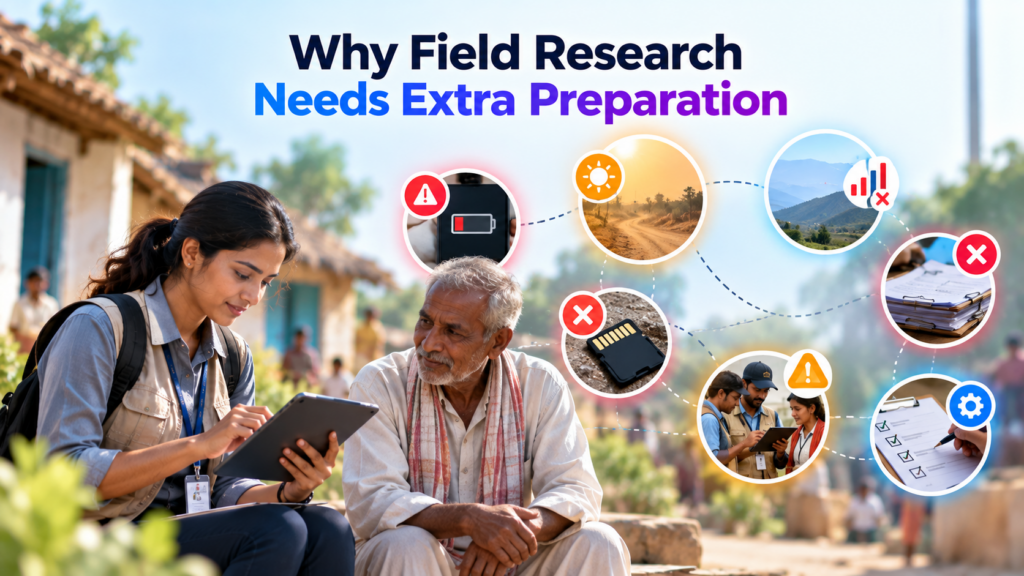
Consequently, small oversights can cause large problems:
- Lost data – Unsynced interviews disappear if a device fails.
- Wasted days – Surveyors arrive without the right survey version.
- Weak quality – Untrained staff rush or skip questions.
- Fraud risk – Fabricated interviews slip through without checks.
- Rework costs – Errors found late require repeat visits.
A structured pre-fieldwork checklist prevents most of these issues before they begin.
Pre-Fieldwork Checklist: Survey and Programming
Start with the survey itself. A flawed survey multiplies mistakes across every interviewer.
- Finalize the questionnaire – Lock wording and logic before programming ends.
- Test every path – Complete the survey using different answer combinations.
- Check validation rules – Confirm the survey blocks impossible answers.
- Test offline – Run the full survey without a connection.
- Review media files – Compress large images to protect storage and speed.
- Confirm the survey version – Make sure everyone uses the latest release.
Careful survey programming at this stage saves enormous effort later. Fixing a logic error in the office takes minutes. Fixing it after hundreds of interviews can take weeks.
Turn Survey Data Into Business Decisions Faster
Technology-driven market research for faster, smarter insights.
Pre-Fieldwork Checklist: Devices
Devices carry your entire project into the field. Treat them accordingly.
- Update the app – Current versions reduce bugs and syncing problems.
- Charge fully – Long days drain batteries quickly.
- Free storage space – Responses, photos, and audio need room.
- Enable permissions – Location, microphone, and camera access must be active where needed.
- Set time and date correctly – Wrong timestamps weaken quality checks.
- Pack backup power – Carry power banks and spare devices.
Additionally, label each device and record which surveyor uses it. This simple habit speeds up troubleshooting when something goes wrong.
Pre-Fieldwork Checklist: Team and Training
Technology can’t replace a well-prepared team. Surveyors determine whether interviews succeed.
- Train on the questionnaire – Surveyors should understand every question’s intent.
- Practice with the app – Hands-on sessions build confidence with navigation and syncing.
- Explain quality controls – Staff should know about GPS, timestamps, and audio checks.
- Clarify sampling rules – Everyone must understand who qualifies and how to select respondents.
- Set sync routines – Define when and how often surveyors upload data.
- Provide support contacts – Make sure surveyors know who to call with problems.
Moreover, run a pilot with a small group before the main launch. Pilots reveal confusing questions, device issues, and training gaps while fixes are still cheap.
How SurveyToGo Supports Field Research
The platform offers several features that suit field conditions.
- Offline Collection
Surveyors complete interviews without a connection. The app stores responses locally and uploads them when the device reconnects. - GPS Capture
Location data confirms that interviews took place where they were supposed to. Supervisors can map coverage and spot unusual patterns. - Timestamps
Start and end times reveal suspiciously short interviews that may signal rushed or fabricated work. - Audio Checks
Short recordings let supervisors verify that interviews followed protocol. - Loops and Logic
Complex routing and repeated question blocks handle multi-person or multi-item studies efficiently.
Together, these tools create layers of verification. As a result, researchers can trust field data without watching every interview.
Managing Fieldwork Day to Day
Preparation matters, but daily management keeps projects healthy. Supervisors should build simple routines.
- Morning Checks
Confirm that devices are charged, apps are updated, and surveyors know their assignments. - Midday Monitoring
Review incoming data for unusual patterns, such as extremely short interviews or clustered locations. - End-of-Day Syncing
Collect completed interviews, confirm uploads, and resolve device problems before the next day. - Regular Feedback
Share quality findings with surveyors quickly. Early feedback corrects bad habits before they spread.
Strong data collection and survey habits depend on this daily rhythm. Small, consistent checks catch problems long before they threaten the final dataset.
Common Field Research Challenges
Even well-prepared teams face obstacles. Recognizing them early helps you respond calmly.
- Connectivity gaps – Sync delays occur in remote areas.
- Battery failures – Devices die during long interview days.
- Respondent refusal – Low cooperation reduces completes.
- Surveyor shortcuts – Rushed interviews lower quality.
- Curbstoning – Fabricated interviews damage credibility.
- Weather and terrain – Conditions slow movement and strain devices.
Fortunately, training, monitoring, and built-in verification tools reduce the impact of most of these problems.
Field Research in Market Research Projects
Field methods remain essential in many studies. A large market research survey may need face-to-face interviews to reach audiences that online panels miss, such as rural households or older respondents.
Service-focused studies also use field methods. A simple service survey form completed on a tablet at a clinic, bank, or retail outlet captures feedback while the experience is fresh.
Organizations running ongoing programs often build field research into broader marketing research in services strategies. Consistent procedures across waves make trend comparisons far more dependable.
Choosing Field-First or Online-First Tools
No platform fits every project. Field-first tools excel where connectivity is unreliable, and interviewers do the work. Online-first tools suit web panels and self-completion surveys.
For comparison, the Decipher survey platform serves online research well, while SurveyToGo focuses on offline-capable fieldwork. Some projects combine both, using online methods for urban samples and field methods for harder-to-reach groups.
Think about your sample, geography, and timeline before choosing. The right tool matches how respondents will actually participate.
Turn Complex Datasets Into Strategic Business Growth
Enterprise-grade data processing, statistical analysis, and customized tabulations to power your insights.
From Field Data to Findings
Once fieldwork ends, careful analysis turns responses into decisions. First, check that every expected interview arrived. Compare synced counts with field records, and investigate any gaps.
Next, review quality indicators such as GPS patterns, timestamps, and audio spot checks. Remove or flag interviews that fail verification before analysis begins.
Then, explore appropriate data analysis tools to compare groups, test hypotheses, and model relationships. Finally, follow a clear approach to writing a data analysis report so decision-makers can act on the findings.
Best Practices for SurveyToGo Field Research
- Complete a thorough pre-fieldwork checklist for the survey, devices, and team.
- Run a pilot before the main launch.
- Test the survey fully in offline mode.
- Train surveyors on both content and quality controls.
- Monitor data daily rather than waiting until the end.
- Sync regularly and confirm uploads before clearing devices.
- Review verification data promptly and give feedback fast.
- Keep detailed records of devices, versions, and changes.
Following these habits protects both your budget and your credibility.
Program Complex Questionnaires and Skip Logic
Expert survey scripting, advanced routing, and multi-language configurations for flawless data collections.
Conclusion
SurveyToGo field research combines mobile technology with careful human management. Offline capability, GPS checks, timestamps, and audio verification help teams collect trustworthy data in challenging environments.
Still, tools alone don’t guarantee quality. Thorough preparation, strong training, daily monitoring, and prompt feedback make the difference between a smooth project and an expensive one. Teams that treat the checklist seriously reach the field ready and return with data they can defend.
Ultimately, good field research is built before the first interview begins.
Frequently Asked Questions
It’s research where interviewers collect responses in person using the SurveyToGo mobile app, with offline support and built-in quality verification.
Test the survey in offline mode, update and charge devices, train surveyors, confirm survey versions, and run a pilot before the main launch.
GPS capture, timestamps, and audio checks let supervisors verify where, when, and how interviews took place.
Yes, surveyors can complete interviews offline, and the app syncs stored responses once the device reconnects.
A pilot reveals confusing questions, device problems, and training gaps while fixes are still quick and inexpensive.