

If you have ever wondered what coding is in data analysis, you’re not alone. Many people confuse it with programming, but the two concepts are entirely different. Coding in data analysis refers to organizing raw information, especially text-based responses, into labelled categories that reveal patterns and themes.
This process turns messy, unstructured data into something researchers can actually analyze. Whether you’re studying customer feedback, interview transcripts, or open-ended survey responses, coding is the foundation that makes meaningful analysis possible.
In this guide, we’ll break down exactly what coding is in data analysis, why it matters, how it works, and how to do it correctly.
What Is Coding in Data Analysis?
Coding in data analysis is the process of labelling and organizing qualitative data to identify recurring themes, patterns, and relationships. Analysts assign short labels, called codes, to words, phrases, or sections of text that represent important ideas within the data.
Coding is used most often in qualitative research, where data typically comes in the form of interview transcripts, open-ended survey answers, or written feedback. Since this data isn’t naturally numerical, it cannot be analyzed using traditional statistical methods right away. Coding solves this problem by transforming text into structured categories that can then be examined systematically.
However, coding is not simply about tagging words. It’s an iterative process. Analysts revisit their codes repeatedly, refining definitions and reorganizing categories as they gain a deeper understanding of the data. This is why understanding what coding is in data analysis requires seeing it as an evolving process rather than a one-time task.
Why Coding Matters in Data Analysis
Coding plays a central role in transforming unstructured information into something usable. Without it, large volumes of open-ended responses would remain difficult to summarize or compare.
Here’s why coding is so important:
- It converts unstructured text into structured, analyzable categories
- It helps researchers spot patterns that aren’t obvious from reading alone
- It supports consistency, since every response is evaluated against the same set of codes
- It allows qualitative data to be paired with quantitative methods later on
- It improves accuracy when reporting findings to stakeholders
Because of these benefits, coding has become essential across market research, academic studies, and customer experience analysis. Anyone trying to understand how data analysis actually works in practice will quickly encounter coding as a foundational step in the process.
Turn Survey Data Into Business Decisions Faster
Technology-driven market research for faster, smarter insights.
Coding vs. Data Analysis: Are They the Same?
It’s easy to confuse coding with the broader analysis process, but they are not identical. Coding is a preparation step. Analysis is what happens after the data has been coded.
Think of it this way: coding organizes the raw material, while analysis interprets what that organized material means. This distinction matters because many beginners assume coding and analyzing are interchangeable terms. Understanding the difference between related concepts, similar to how professionals distinguish data analysis from data analytics, helps clarify exactly where coding fits into the larger research workflow.
Types of Coding in Data Analysis
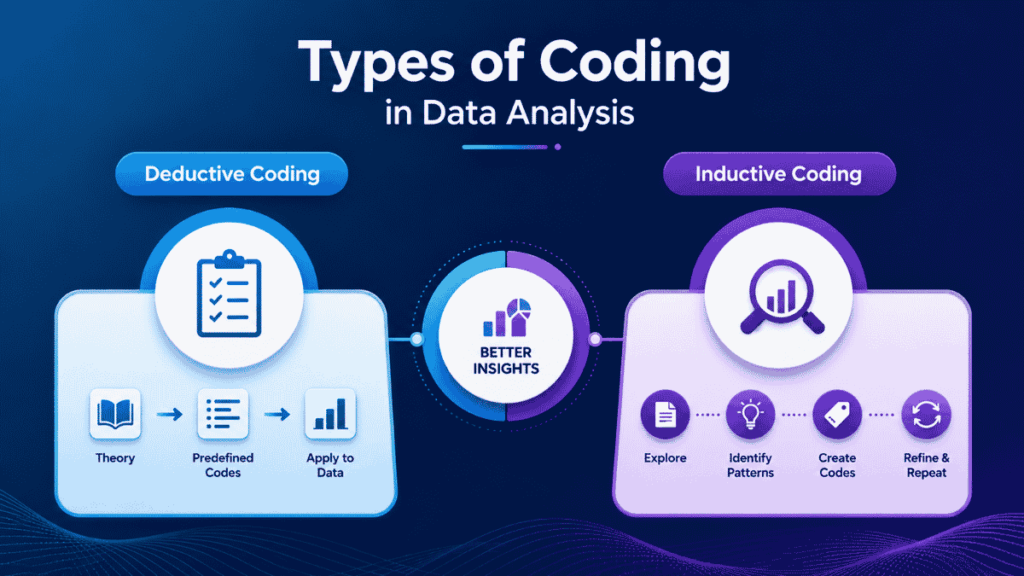
There are two primary approaches to coding qualitative data: deductive and inductive. Understanding both is essential to answering what coding is in data analysis in a practical sense.
Deductive Coding
Deductive coding starts with a predefined set of codes. Researchers typically build these codes based on prior research, established theory, or specific questions they want answered.
For example, if a company wants to understand complaints about wait times, “long wait time” might be created as a code before any data is reviewed. This approach saves time, but it can introduce bias if researchers only look for what they expect to find.
Inductive Coding
Inductive coding, on the other hand, starts from scratch. Codes emerge directly from the data itself rather than from a predetermined list. This approach is slower, but it produces a more complete and unbiased picture of what the data actually contains.
Inductive coding typically follows these steps:
- Break the dataset into smaller, manageable samples
- Read through the sample and create initial codes
- Apply those codes to the rest of the sample
- Refine and adjust codes as new patterns emerge
- Repeat the process until the entire dataset is coded consistently
Many researchers combine both approaches, starting inductively to avoid missing important themes, then applying deductive logic once clear patterns are established.
Turn Complex Datasets Into Strategic Business Growth
Enterprise-grade data processing, statistical analysis, and customized tabulations to power your insights.
How to Code Qualitative Data: Step-by-Step
Now that we’ve covered what coding is conceptually in data analysis, let’s walk through the practical steps involved.
Step 1: Prepare Your Data
Before coding begins, gather and organize your raw data. This might include survey responses, interview transcripts, or written feedback. Clean formatting at this stage prevents confusion later. This preparation stage closely mirrors standard data collection and survey practices, where organized input data leads to more reliable results.
Step 2: Read Through the Data First
Before assigning any codes, read through a sample of your data to understand its general tone and content. This step helps you avoid jumping to conclusions too early.
Step 3: Create Initial Codes
Assign short labels to meaningful words, phrases, or sections of text. Keep codes specific enough to be useful, but broad enough to apply across multiple responses.
Step 4: Build a Coding Frame
Organize your codes into a structured framework, either flat or hierarchical. A flat frame treats every code equally, while a hierarchical frame groups related codes under broader categories. Hierarchical frames tend to work better for larger datasets since they allow more nuanced organization.
Step 5: Apply Codes Consistently
Go through the entire dataset and apply your codes consistently. If new themes emerge, update your coding frame and revisit previously coded data to ensure consistency across the board.
Step 6: Analyze the Coded Data
Once coding is complete, you can begin analyzing frequency, relationships, and patterns among the coded categories. This stage is where coding truly becomes valuable, since it enables both qualitative and quantitative interpretation. Clear, structured findings at this point make it far easier to follow best practices for how to create a strong data analysis report later on.
Common Coding Methods Used in Data Analysis
Several established methods fall under the broader umbrella of qualitative coding. Each serves a slightly different analytical purpose.
- Thematic coding – Identifies broad themes and recurring patterns across responses
- Content coding – Quantifies themes by counting how often specific concepts appear
- Process coding – Captures actions or sequences of events within narrative data
- Structural coding – Organizes data based on predetermined structural categories
- Emotion coding – Labels emotional tone or sentiment expressed within responses
Choosing the right method depends on your research goals. For example, content coding works well when you need numerical frequency counts, while thematic coding is better suited for exploratory research.
Manual vs. Automated Coding
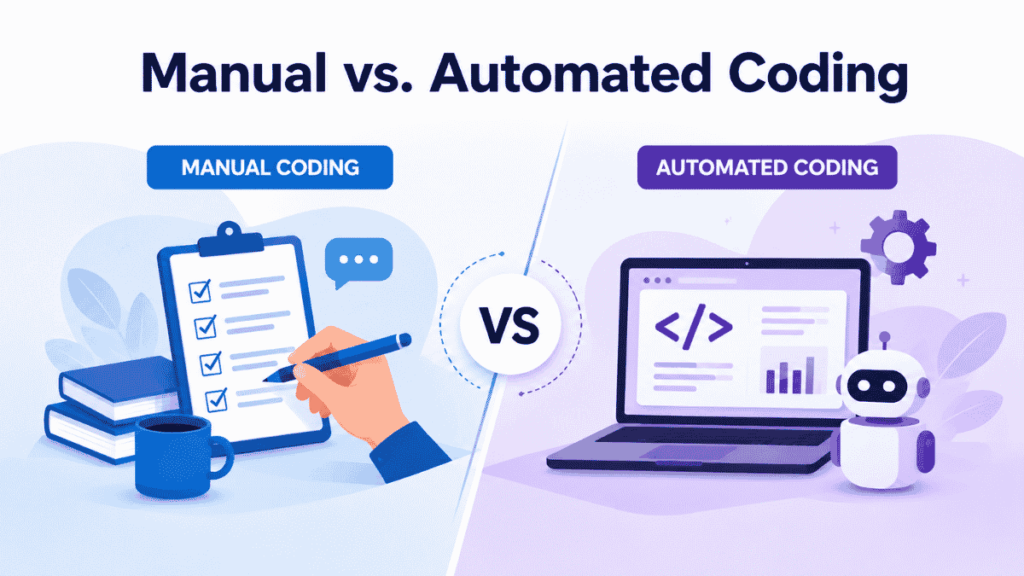
Coding can be done manually or with the help of software tools. Each approach has distinct advantages and trade-offs.
Manual Coding
Manual coding gives researchers full control over how codes are defined and applied. However, it can be extremely time-consuming, especially with large datasets. It also carries a higher risk of inconsistency, particularly when multiple researchers are involved.
Automated Coding
Automated coding uses natural language processing and artificial intelligence to identify themes and assign codes at scale. This approach dramatically speeds up analysis and reduces certain types of human bias. Nevertheless, human oversight remains important, since automated systems can still misinterpret nuance or context.
Many professional teams rely on structured data analysis tools that combine automation with manual review, giving researchers the speed of AI alongside the accuracy of expert judgment.
Best Practices for Effective Coding
To ensure your coding process produces reliable, usable results, follow these best practices:
- Maintain a codebook that documents every code, its definition, and examples
- Avoid creating codes that are too broad or too narrow to be useful
- Group similar responses under the same code, even if wording differs
- Watch for definitional drift, where early and late coding decisions become inconsistent
- Have multiple coders cross-check each other’s work when possible
- Keep your coding frame flexible enough to adapt as new themes emerge
Following these practices ensures your coded data remains accurate and genuinely useful during later analysis stages.
Coding’s Role in Quantitative vs. Qualitative Research
While coding is most closely associated with qualitative research, it also plays a role in quantitative contexts. In quantitative research, coding often refers to converting categorical responses into numerical values for statistical analysis. This is a narrower, more mechanical process compared to qualitative coding.
Understanding this distinction is important, especially for researchers moving between both traditions. Those working extensively with numerical datasets will recognize similarities to structured approaches used in data analysis and interpretation in quantitative research, where consistent categorization also plays a critical role in producing reliable results.
Program Complex Questionnaires and Skip Logic
Expert survey scripting, advanced routing, and multi-language configurations for flawless data collections.
Common Challenges When Coding Data
Coding qualitative data isn’t without difficulty. Here are challenges analysts frequently encounter:
- Overcoding – Creating too many narrow codes, which complicates analysis
- Undercoding – Using overly broad categories that hide important nuance
- Coder bias – Personal assumptions influencing how codes are applied
- Inconsistent application – Different coders interpreting the same code differently
- Time constraints – Manual coding becoming impractical with very large datasets
Recognizing these challenges early helps teams plan realistic timelines and choose the right coding method for their project.
Conclusion
So, what is coding in data analysis? At its core, it’s the process of transforming unstructured text into organized, analyzable categories. Whether you choose deductive or inductive coding, manual or automated methods, the goal remains the same: uncovering meaningful patterns hidden within raw data.
Coding requires patience, consistency, and a willingness to refine your approach as new themes emerge. When done correctly, it becomes the bridge between raw feedback and genuinely actionable insight, making it one of the most valuable skills in any researcher’s toolkit.
FAQs
Coding in data analysis is the process of labelling text or responses with short categories, called codes, to identify recurring themes and patterns within the data.
Coding is most common in qualitative research, but similar categorization principles also apply when preparing categorical variables for quantitative analysis.
Deductive coding starts with predefined categories, while inductive coding builds codes directly from the data as patterns emerge, without a preset framework.
Yes. Many tools now use natural language processing to automate coding at scale, though human review is still recommended to ensure accuracy and context.
Use a documented codebook, involve multiple coders when possible, and regularly cross-check coding decisions to catch inconsistencies or personal bias early.