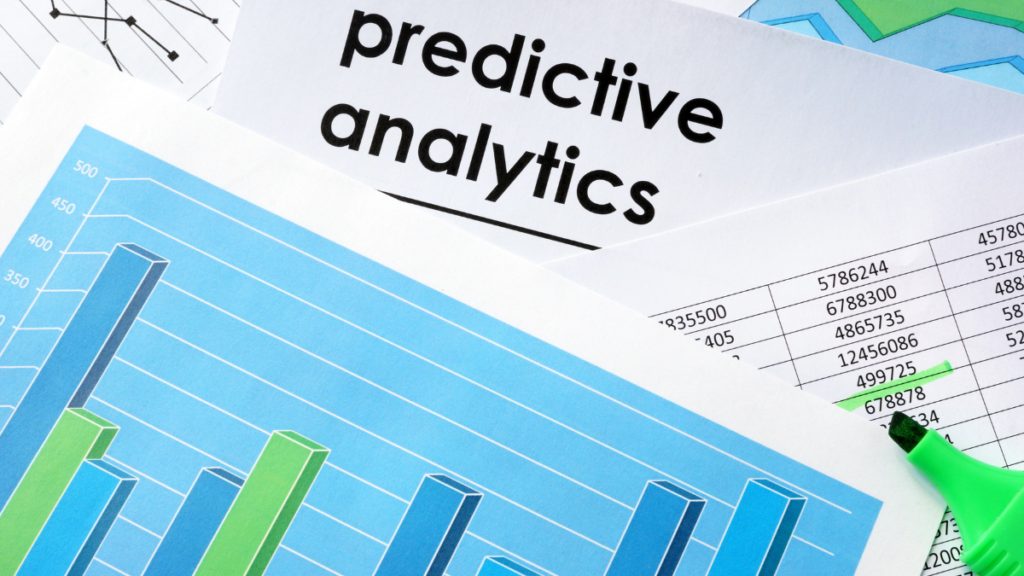
Businesses today sit on mountains of historical data, yet turning that data into reliable forecasts still trips up many teams. TensorFlow predictive analytics addresses this gap directly, giving developers and data scientists an open-source framework built specifically for training models that predict future outcomes from past patterns.
From forecasting revenue to flagging fraudulent transactions, TensorFlow predictive analytics has become a go-to approach for organizations that need scalable, production-ready machine learning. This guide walks through the practical side of implementing TensorFlow for predictive work, the skills required, and how it fits into the wider analytics landscape. At Linkinfotech, we help organizations bridge this gap, applying predictive modeling techniques to real business data so forecasts translate into practical, actionable decisions.
What Makes TensorFlow Suited for Predictive Analytics?
TensorFlow was built by Google as a general-purpose machine learning library, but it has become particularly well-suited to predictive analytics work for a few specific reasons.
First, TensorFlow handles both structured and unstructured data effectively. Structured, tabular data like sales figures or customer records works well alongside unstructured data like images or text, all within the same framework. This versatility means TensorFlow predictive analytics can support very different projects without switching tools.
Second, TensorFlow is designed for the full model lifecycle, not just experimentation. Many frameworks are strong for research but weak for deployment. TensorFlow, however, includes tools for exporting trained models directly into web apps, mobile devices, and production servers, which shortens the path from prototype to real-world use.
Finally, TensorFlow scales efficiently. A model built and tested on a small sample dataset can later be retrained on much larger volumes without a complete rebuild, which matters greatly as organizations accumulate more historical data over time.
Implementing TensorFlow for Predictive Analytics: The Practical Skills
Learning to implement TensorFlow predictive analytics in a real project requires more than understanding the theory behind neural networks. It requires hands-on familiarity with the tools, workflow, and common pitfalls involved in building working models.
Setting Up the Environment
Before building anything, you need a properly configured environment. This typically includes installing TensorFlow itself, along with supporting libraries for data manipulation and visualization. Getting this setup right the first time avoids frustrating compatibility issues later in the project.
Preparing and Structuring Data
Data rarely arrives ready for modeling. It usually needs cleaning, reformatting, and restructuring into a format TensorFlow can process efficiently. This preparation stage overlaps closely with foundational data analysis work, since a model is only as reliable as the data used to train it.
Turn Survey Data Into Business Decisions Faster
Technology-driven market research for faster, smarter insights.
Choosing a Model Architecture
TensorFlow offers multiple approaches depending on your prediction goal, from simple linear models to deep, multi-layered neural networks. Beginners often start with simpler architectures, gradually adding complexity only when a simpler model fails to capture the patterns in the data.
Training and Tuning
Once a model architecture is chosen, training begins. This stage involves feeding data through the model repeatedly, adjusting internal parameters, and tuning settings like learning rate to improve accuracy without overfitting.
Testing Before Deployment
A model that performs well on training data isn’t necessarily ready for production. Testing against unseen data confirms whether the model generalizes correctly before it’s trusted with real business decisions.
Common Predictive Analytics Tasks Built With TensorFlow
TensorFlow predictive analytics supports several distinct categories of prediction tasks, each requiring a slightly different modeling approach.
- Regression tasks – Predicting a continuous number, such as expected monthly revenue
- Binary classification – Predicting one of two outcomes, such as churn versus retention
- Multi-class classification – Predicting among several possible categories, such as product recommendation groups
- Time-based forecasting – Predicting values that unfold sequentially, such as daily website traffic
- Anomaly detection – Identifying unusual patterns that deviate from expected behavior, such as fraud
Each of these tasks uses the same underlying TensorFlow tools, adapted through different model architectures and loss functions suited to the specific prediction goal.
Why Data Exploration Comes Before Model Building
A common mistake among newcomers to TensorFlow predictive analytics is jumping straight into model architecture without first exploring the data. Skipping this step often leads to wasted training cycles on models built with weak or irrelevant input variables.
Before building anything, it helps to examine which variables actually relate to your target outcome. This exploratory work mirrors the principles behind correlation analysis in statistics, where identifying meaningful relationships between variables guides which features are worth including in a model in the first place.
TensorFlow and Sequential or Time-Based Data
A significant portion of predictive analytics work involves data that changes over time, such as sales trends, sensor readings, or customer engagement metrics. TensorFlow includes specialized architectures, particularly recurrent neural networks and LSTM layers, designed to handle exactly this kind of sequential information.
Understanding foundational concepts from time series analysis helps clarify why these specialized architectures exist. Trends, seasonality, and sequential dependency all need to be captured differently than they would be in a standard, non-sequential dataset.
Segmenting Data Before Predictive Modeling
Not every dataset benefits from a single, one-size-fits-all model. In many TensorFlow predictive analytics projects, it makes sense to first group similar records together, then build separate, specialized models for each group.
This segmentation approach draws on concepts from cluster analysis in data mining, where records sharing similar characteristics are grouped. Applying this thinking before modeling often improves accuracy, since a single generalized model can struggle to capture patterns that differ significantly across distinct customer or product segments.
Academic and Research Perspectives on TensorFlow Predictive Analytics
Beyond industry applications, TensorFlow predictive analytics has also become a significant focus within academic and research communities. Peer-reviewed research consistently explores how deep learning architectures built on TensorFlow compare against traditional statistical forecasting methods across different domains.
Program Complex Questionnaires and Skip Logic
Expert survey scripting, advanced routing, and multi-language configurations for flawless data collections.
This research-driven perspective matters because it validates which approaches genuinely improve prediction accuracy versus which simply add unnecessary complexity. For practitioners, staying aware of this academic context helps inform decisions about when a simpler statistical model might outperform a more elaborate TensorFlow-based neural network, and when the added complexity is genuinely worthwhile.
Comparing TensorFlow to Simpler Predictive Approaches
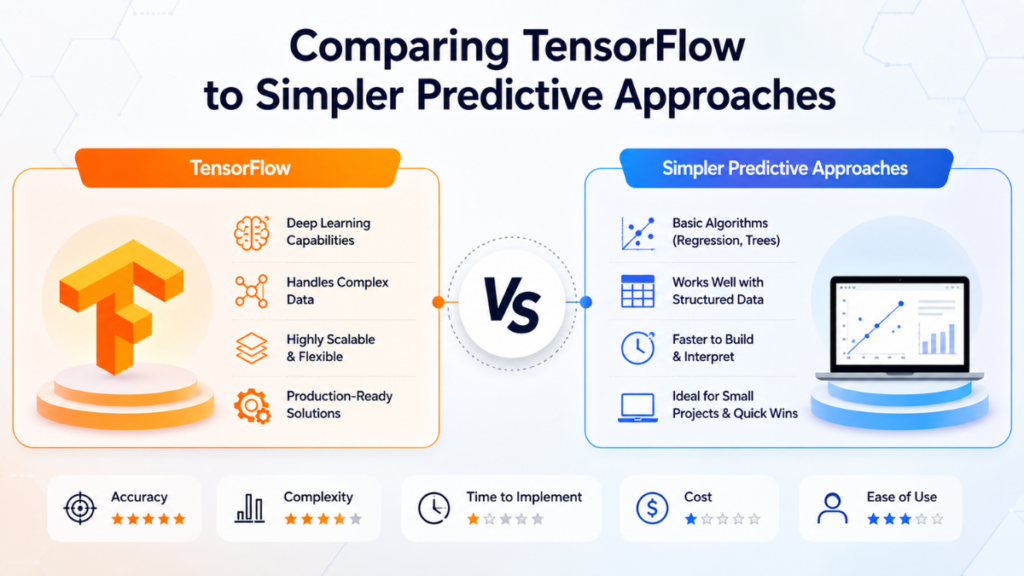
Not every predictive analytics problem requires the full power of TensorFlow. Sometimes, a simpler statistical model produces comparable accuracy with far less development time and computational cost.
Understanding when to reach for TensorFlow versus a simpler approach ties closely into the broader distinction between predictive analytics and data analytics more generally. Predictive analytics specifically forecasts future outcomes, and the tool chosen to do that forecasting should match the complexity of the problem, not simply reflect the most advanced technology available.
From Prediction to Action
Building an accurate TensorFlow model answers the question of what’s likely to happen. However, organizations often need to go a step further and decide what to actually do in response to that prediction.
This is where prescriptive approaches come in, building directly on top of predictive outputs. Reviewing a clear example of prescriptive analytics helps illustrate this next step, showing how a TensorFlow prediction about, say, customer churn risk can feed directly into a specific recommended retention action.
Evaluating Whether Your Model Actually Works
Once trained, a TensorFlow predictive analytics model needs rigorous evaluation before anyone trusts its output for real decisions. Key evaluation approaches include:
- Holdout validation – Testing performance on data the model never saw during training
- Cross-validation – Repeatedly testing across different data subsets for a more reliable accuracy estimate
- Confusion matrices – Breaking down classification errors by category for deeper insight
- Error metrics – Using measures like mean absolute error for regression-based predictions
Skipping thorough evaluation is one of the most common reasons predictive models fail once deployed, since strong training performance doesn’t guarantee real-world reliability.
Interpreting Results Responsibly
Producing a prediction is only half the job. Communicating what that prediction actually means, including its limitations and confidence level, matters just as much. This mirrors the standards expected in data analysis and interpretation in quantitative research, where conclusions must be presented honestly, with appropriate caveats about uncertainty and model limitations.
Common Pitfalls to Avoid
Teams new to TensorFlow predictive analytics frequently run into a few recurring issues:
- Skipping exploratory analysis – Jumping straight to modeling without understanding the data first
- Overcomplicating the model – Choosing a deep neural network when a simpler model would perform just as well
- Ignoring data imbalance – Training on datasets where one outcome vastly outnumbers another, skewing predictions
- Neglecting ongoing monitoring – Deploying a model and never checking whether its accuracy degrades over time
- Underestimating compute needs – Failing to plan for the processing power larger models require
Avoiding these pitfalls comes down to discipline: treating data preparation and evaluation with the same seriousness as model architecture itself.
Best Practices for Real-World Implementation
To build TensorFlow predictive analytics models that hold up outside the training environment, keep these practices in mind:
- Start with a clearly defined, measurable prediction goal
- Explore and clean your data thoroughly before writing any model code
- Choose the simplest architecture capable of solving the problem
- Validate rigorously using data the model has never seen
- Monitor deployed models continuously and retrain as needed
- Document assumptions and limitations alongside every prediction
Following this discipline consistently separates models that deliver lasting business value from those that quietly fail once real-world data starts flowing in.
Turn Complex Datasets Into Strategic Business Growth
Enterprise-grade data processing, statistical analysis, and customized tabulations to power your insights.
Conclusion
TensorFlow predictive analytics gives teams a flexible, production-ready path from historical data to forward-looking forecasts. Its strength lies not just in raw modeling power, but in supporting the full journey from data preparation through deployment and ongoing monitoring.
Success with TensorFlow predictive analytics depends less on chasing the most advanced architecture and more on disciplined data preparation, thoughtful model selection, and honest evaluation. Teams that follow this structured approach consistently build predictive systems that hold up well beyond the training environment.
FAQs
Not always. Simpler statistical methods often perform just as well for straightforward problems, while TensorFlow’s strength shows in complex, large-scale, or unstructured data scenarios.
You’ll need programming knowledge, typically in Python, along with an understanding of data preparation, model evaluation, and basic machine learning concepts.
TensorFlow includes recurrent neural network architectures, including LSTM layers, specifically designed to capture patterns in sequential, time-based data.
Skipping data exploration and jumping straight into model building is one of the most common mistakes, often resulting in models trained on weak or irrelevant input variables.
Rigorous testing against unseen data, along with ongoing performance monitoring after deployment, confirms whether a model generalizes well enough for real-world use.